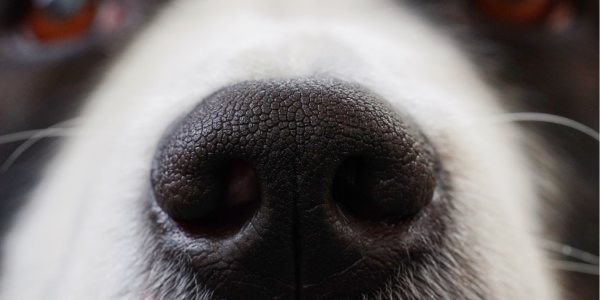
Have you ever watched your dog freeze mid-walk, nose lifted to the breeze, completely engrossed in something invisible to you? While we rely primarily on our eyes to navigate our surroundings, our dogs live in a rich, three-dimensional tapestry built almost entirely of smell.
Understanding how scent works isn’t just fascinating biology – it fundamentally changes how you view your dog’s daily walks, their training, and their behaviour. Here is a look inside the incredible world of our dogs nosework.
To understand how dogs track us, we first have to look at what we leave behind. Every single minute, you shed roughly 40,000 dead skin cells.
Think of these as microscopic rafts carried on air currents. Packed with your personal blend of bacteria, sweat, and natural oils, they fall continuously onto grass, hedges, pavement, and moss. Because every human has a completely distinct bacterial ecosystem, your “skin raft” trail creates an individual scent fingerprint.
Whether you’re walking, sitting, or just standing still, you are constantly scattering an invisible breadcrumb trail that your dog can read like a newspaper.
If human sense of smell is a small pocket torch, a dog’s nose is a stadium floodlight.
While humans possess a modest 5 million scent receptors, dogs boast around 220 million. The area of their brain dedicated to analysing scent – the olfactory bulb – is proportionally 40 times larger than ours. To put that in perspective, a dog could detect a single drop of a specific substance dissolved in an Olympic-sized swimming pool!
• Dual Airflow Channels: When your dog sniffs, air doesn’t just go in and out. Their nasal anatomy divides the air stream into two distinct paths: one for breathing and one dedicated entirely to smelling.
• Stereo Sniffing: Each nostril functions independently. By measuring micro-differences in odor strength between the left and right nostril, your dog can instantly tell whether a scent turned left or right.
• The Turbinates: Deep inside the nasal cavity, intricate scroll-shaped bones called turbinates act like net catchers, trapping scent molecules so receptors can process them thoroughly.
• The Jacobson’s Organ (Vomeronasal Organ): Located in the roof of the mouth, this secret weapon bypasses regular smell pathways and connects directly to the emotional and instinctive centers of the brain. If you’ve ever seen your dog “flick” their tongue or open their mouth slightly while sniffing, they are pulling chemical signals into this organ to evaluate hormones, stress levels, and identity.
One of the biggest breakthroughs for dog owners is realising that scent is dynamic. It doesn’t sit neatly on the ground where a footprint fell.
Warm Air / Sun – Scent Rises & Disperses
Cool / Damp Air – Scent Stays Low & Heavy
Wind / Obstacles – Scent Pools & Drifts
• Temperature: Heat causes scent to rise and dissipate quickly; cooler air keeps scent close to the ground.
• Humidity: Moisture acts as a preservative for scent particles. Shaded, damp woods hold rich scent trails for hours or even days, while hot, dry tarmac destroys them fast.
• Wind & Terrain: Wind creates “scent pools” against fences or trees, while urban concrete creates wind tunnels that shift the trail far away from where the person actually walked.
Instead of treating your next walk as a physical exercise routine, turn it into an observation experiment. You will start seeing your dog’s nosework mechanics in real time!
1. Choose a 10-minute stretch of your walk on or off a long lead where your dog can explore safely without being rushed.
2. Observe & Count: See how many of these specific scent-reading behaviours you can spot:
o The Air Sniff: Head held high, nostrils flared. They are catching airborne scents carried by wind currents.
o The Ground Trace: Nose glued to the surface, rapid inhaling. They are following settled skin rafts on a physical track.
o The Tongue Flick: A quick lick of the air or a subtle mouth-gape. They are actively drawing pheromones into their Jacobson’s organ.
o The Circle-Back: Your dog overshoots a trail, pauses, and makes a loop. They hit a “scent drop-off” where the wind shifted, and are recalibrating.
3. Take Note of the Environment: Did they spend longer sniffing in cool, damp grass compared to dry pavement? Did a gust of wind suddenly cause them to raise their head?
Once you start spotting these subtle behaviours, you’ll never look at a standard dog walk the same way again!
Loved learning about how your dog’s nose works? Explore our Beginners Theory Course for Mantrailing, starting in September 2026!
Know someone who might find this useful? Share it with them...